
Energy efficiency is a powerful selling point, and one of the most wasted. Find out how to communicate energy efficiency to ordinary buyers in a way that closes decisions.
There is a conversation that happens more and more often in property project presentations in Portugal.
The architect or developer explains, in detail and with genuine pride, everything that has been done in the name of sustainability: the A+ energy certificate, the 12cm ETICS insulation, the photovoltaic panels with a 7 to 9-year payback, the mechanical ventilation with heat recovery, the low-emissivity double glazing.
The buyer listens. Nods. And at the end asks:
“But does the kitchen get a lot of natural light?”
It is not ignorance. It is priority.
The ordinary buyer does not buy energy efficiency. They buy comfort, security and a better version of their life. Energy efficiency is a means to that end, and when it is presented as an end in itself, it gets lost in translation.
This article is about how to do that translation. How to turn technicalities into benefits the ordinary buyer can feel, imagine and use as an argument for paying more.
The problem with technical language
Over decades, the construction industry has developed a language of its own. Rich, precise and completely inaccessible to anyone who does not live in it.
A+ energy certificate. Efficiency class. U-value of the building envelope. Solar factor of the glazing. NZEB. Passivhaus. LEED pre-certification.
These expressions have real and important meaning. But for a buyer deciding where they will live for the next 20 years, or where to invest a lifetime's savings, they are abbreviations without emotional context.
And without emotional context, there is no decision.
The problem is not that buyers do not value sustainability. Market research is clear: energy efficiency is an increasingly important purchasing criterion, especially among younger generations and international buyers. The problem is that the way it is communicated does not trigger that appreciation.
The solution is not to simplify. It is to translate.
How to communicate energy efficiency to buyers: from technical to tangible
Every energy efficiency feature has a direct consequence for the buyer's life. And it is that consequence, not the feature, that should be communicated.
The structure is always the same:
Technical feature → real benefit → lived experience
It is not about hiding the technical side. It is about placing it within an experience the buyer can imagine.
Here are the most important translations:
High-performance thermal insulation
How it is usually communicated: “12cm ETICS insulation with a thermal transmittance of U=0.28 W/m²K.”
How it should be communicated: “In winter, the home stays warm for hours without the heating on. In summer, it stays cool without the air conditioning running all day. What you feel inside is independent of what is happening outside.”
The mental image this creates, the feeling of being in a home that protects you, a refuge independent of the weather, is far more powerful than any coefficient.
Low-emissivity double glazing
How it is usually communicated: “Thermally broken aluminium frames with low-emissivity double glazing, Ug=1.1 W/m²K.”
How it should be communicated: “You can sit by the windows in winter without feeling cold. No draughts. None of the discomfort of being near the glass. The light comes in. The cold does not.”
This benefit is immediately understood by anyone who has lived in an old flat with windows that “frosted over” in winter. The recognition is instant, and it creates an emotional contrast that positions the project as a clear step forward.
Photovoltaic panels and energy generation
How it is usually communicated: “5kWp photovoltaic system with an estimated payback of 7 to 9 years.”
How it should be communicated: “The electricity bill stops being a monthly worry. In many months the home produces more energy than it uses, and the difference is fed back to the grid or stored. It is like owning an asset that works while you live.”
The idea that the home “works” for the buyer, generating value instead of just consuming it, is a shift in perspective that resonates especially well with investment-minded buyers.
Mechanical ventilation with heat recovery
How it is usually communicated: “MVHR system with heat recovery efficiency above 85% and a fresh-air flow rate that keeps indoor air quality above the regulatory minimum.”
How it should be communicated: “The air in the home is renewed continuously, without opening the windows. No dust, no pollen, no outside noise coming in. The indoor air quality is better than in most new buildings, and you can feel it, especially if you have allergies or young children.”
The reference to allergies and children turns a technical feature into a solution to a real, personal problem. It is the kind of argument a buyer repeats to a relative to justify their choice.
A or A+ energy certificate
How it is usually communicated: “Class A+ energy certificate, with primary energy needs well below the legal limit, in the top band of the national rating system.”
How it should be communicated: “A home with this energy rating costs significantly less to run than an equivalent home rated B or C. Over 20 years, the difference can amount to tens of thousands of euros in energy bills. It is an advantage that does not show in the purchase price, but you feel it every month.”
The long-term financial argument is especially relevant at a time of rising energy prices. And when it is quantified in euros and years, it stops being an abstract concept and becomes an investment decision.
3D visualisation as a tool for communicating sustainability
There is one dimension of this conversation that is rarely explored, and it has an enormous impact on the ability to communicate energy efficiency before the building exists:
A 3D render can show the benefits of sustainability instead of stating them.
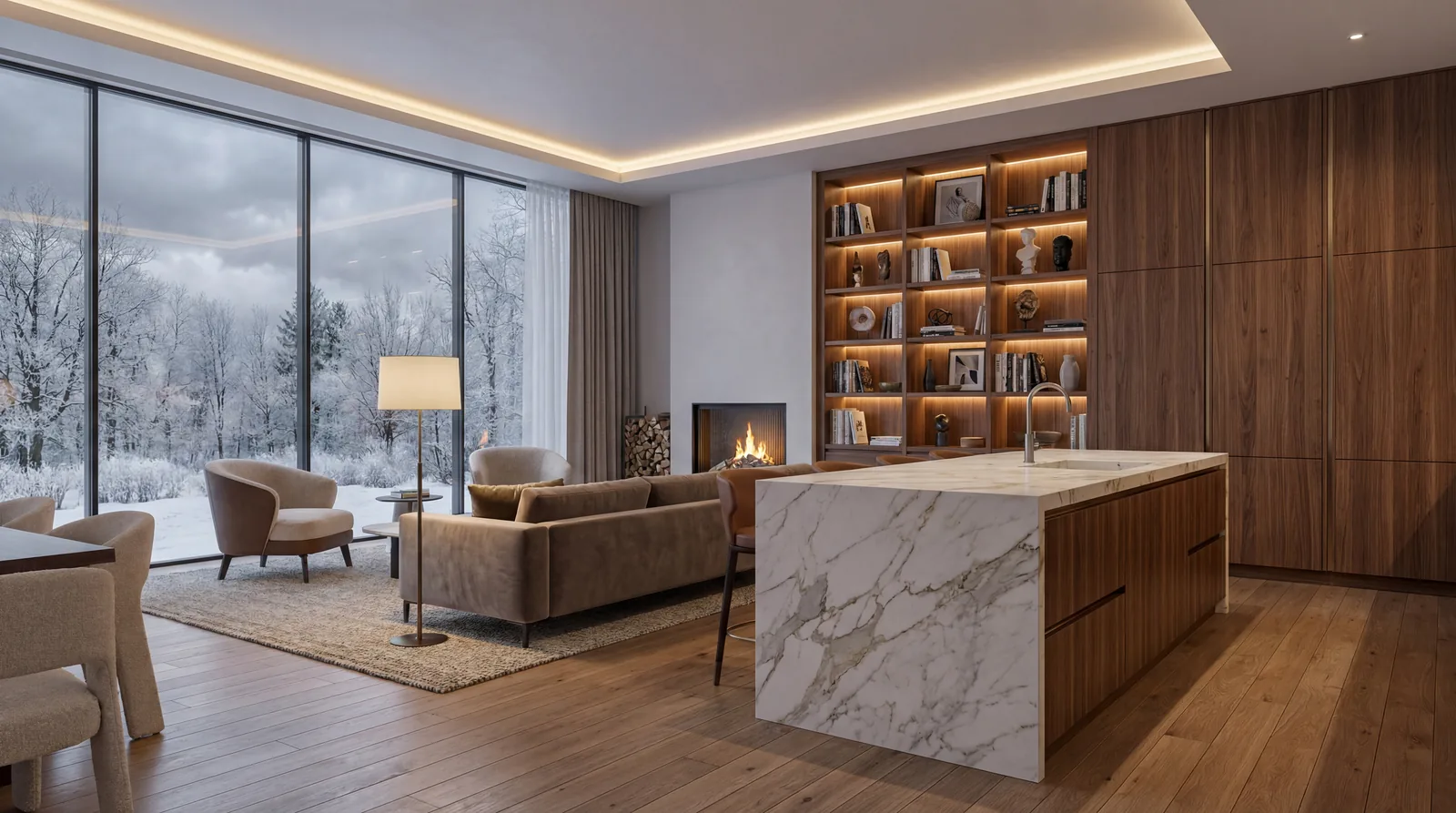
There is no need to write “high-performance insulation” in a brochure. What you need is to show, in an interior render, winter light coming through the window while it is grey outside, and the interior looking cosy and warm. That image communicates insulation without using the word.
There is no need to explain mechanical ventilation. What you need is to show a clean, airy interior with generous natural light, and the caption can simply say “continuously renewed air, no noise, no pollen.”
There is no need to justify the photovoltaic panels with payback tables. What you need is to show the roof with the panels elegantly integrated, and communicate that “this home produces its own energy.”
3D visualisation has the unique ability to make the technical invisible and the benefit visible. And for projects with a sustainability component, where the benefits are real but intangible, that ability is extraordinarily valuable.
The three buyer profiles and what each one values
Not every buyer reacts in the same way to energy efficiency arguments. Knowing the profile before you communicate is as important as the message itself.
The comfort-driven buyer: Does not want to hear about certificates. Wants to know how they will feel in the home. The cold that stays out. The quiet that stays in. Air that is good to breathe. Arguments about insulation, ventilation and quality of materials are the most effective.
The investment-driven buyer: Wants numbers and returns. The lower energy bill. How the property holds its value compared with equivalents rated B or C. The resale price differential in European markets where energy efficiency is a mandatory criterion. The certificate as proof of residual value.
The values-driven buyer: Wants to know the real impact: the tonnes of CO₂ the home will not emit, the renewable energy it will produce, the project's relationship with the environment. They do not need payback figures; they need evidence of genuine intent and consistency between what the project says and what it does.
Most buyers are a mix of all three. What varies is the proportion, and working out that proportion before you begin the presentation determines the order and weight of each argument.
What never to say, and what to say instead
Never: “This project has a BREEAM Very Good rating.” Instead: “This project has been assessed by an independent body as one of the most sustainable in its category in Portugal.”
Never: “The opaque envelope has an average thermal transmittance of 0.35.” Instead: “The walls and roof keep the indoor temperature stable, whatever is happening outside.”
Never: “The photovoltaic system has a payback of 7 to 9 years.” Instead: “From the seventh or eighth year, depending on consumption, the energy the home produces is pure profit. If you plan to stay 20 years, that is money that stays in your pocket.”
Never: “The windows have a solar factor of g=0.35.” Instead: “The windows let the light in without letting excess heat in during the summer, which means less air conditioning and lower bills.”
The rule is always the same: jargon closes doors. Experience opens them.
Sustainability as a price argument
There is a conversation the most forward-thinking developers are already having, and it will become mainstream in the coming years:
Energy efficiency is not an extra construction cost. It is a price argument.
In markets such as Germany, the Netherlands and the United Kingdom, the price difference between a property rated A and one rated B or C is documented and significant. Buyers pay more, and pay well, for homes that cost less to run.
Portugal is on the same path. And the projects already communicating sustainability effectively are capturing that value differential before most people realise it exists.
The question is not whether it is worth communicating energy efficiency.
It is whether you are communicating it in a way the buyer can feel, or in a way only your engineer can read.
Conclusion
Sustainability is one of the most powerful selling points in modern real estate.
And one of the most wasted, because it is communicated in the wrong language to the wrong audience.
The ordinary buyer does not buy coefficients. They buy comfort. They buy savings. They buy the feeling of making a smart decision that will still make sense 20 years from now.
Translating energy efficiency into that language is not simplifying. It is respecting the person who decides, and giving them the tools to decide well.
And when that translation is done through renders that show the benefits instead of stating them, the project does not need to explain why it is worth what it costs.
It becomes obvious.
👉 Have a project with a sustainability component and want to define the right visual communication strategy? Talk to us.
Foreseen Projects (formerly Hugo Guerra Design) is a studio specialising in architectural and real estate 3D visualisation, a strategic partner to architects, developers, builders and interior designers in Portugal.