
Uncover the secret to choosing the perfect 3D technology for your real estate or architecture project. Compare renders, animations and virtual tours to maximise impact and sales, with no waffle.
Hello, visionaries of real estate and architecture! Ready to cut through the noise and get straight to the point? Because that is exactly what we are going to do today. Forget the industry's “waffle”. We are here to talk about real strategy, about how to invest your money wisely and, above all, how to sell more and sell better.
If your head has ever spun with terms like “photorealistic render”, “3D animation” or “interactive virtual tour”, and you wonder which of them is really the holy grail for your next project, then this article is for you. Let us make it simple. Let us give you the “no waffle” guide to making the right decision. Because, at the end of the day, your success is our success.
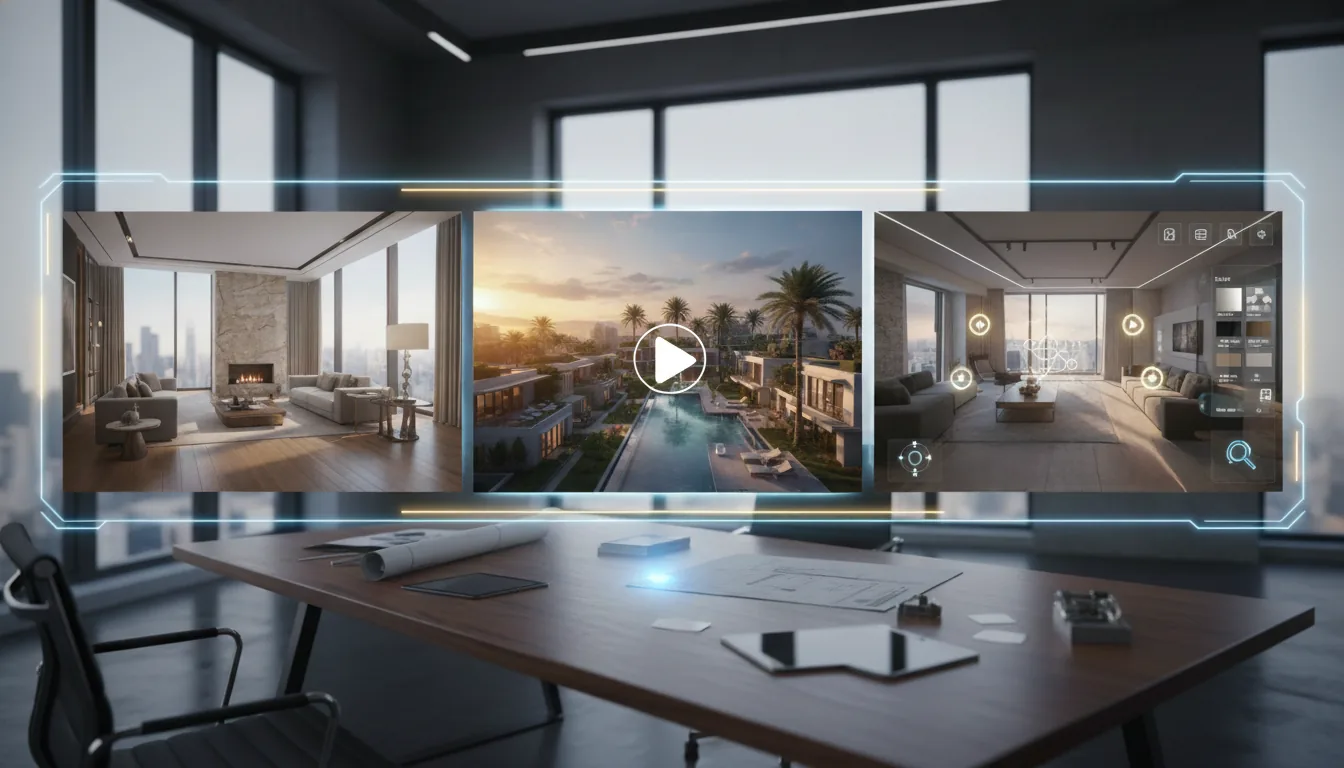
Photorealistic render: the essential workhorse (when simple is more)
Let us be honest: the photorealistic render is the backbone of 3D visualisation. It is your starting point, your visual “elevator pitch”. It turns two-dimensional plans into something tangible, something people can feel. And the truth is that, most of the time, it is all you need to start the conversation and generate that initial “wow”.
Think about it: you are launching a residential development with two- and three-bedroom apartments. Your main focus is to present the interior and exterior design with maximum beauty and clarity. You need images that captivate in brochures, in online listings and at your sales stand. In this scenario, investing in high-quality imagery of the key spaces (living room, kitchen, main bedroom and façade) is gold.
Where renders shine:
-
Controlled costs: It is the most economical option, with the best return on investment for most projects.
-
Speed: They can be produced faster, which is crucial for tight deadlines.
-
Versatility: Perfect for print and digital marketing, billboards and social media.
-
Focus on detail: Ideal for highlighting materials, lighting and specific design features.
Do not underestimate the power of a still image that breathes life. Sometimes less is more, and a well-executed image can be your best salesperson.
3D animation: the narrative experience (when telling a story is essential)
Now, if your project has a story to tell, if you want to take your audience on an emotional and dynamic journey, then 3D animation is your VIP ticket. We are not just talking about showing a building; we are talking about living the building before it even exists.
3D animation is perfect for luxury developments, large urban schemes or complex commercial buildings where experience and flow are crucial. Picture a cinematic video showing the sunrise over your luxury residential tower, the movement of the city outside, and then moving into the interior spaces, highlighting their elegance and functionality. It is immersive, it is engaging, it is unforgettable.
Where animations shine:
-
Emotional immersion: It creates a deeper, more memorable connection with the audience.
-
Context and scale: Ideal for showing the project in its surroundings.
-
Narrative: Perfect for telling the story behind the design and the lifestyle.
-
Complexity: It helps simplify complex architectural designs and communicate them in a digestible way.
But be warned: 3D animation demands a bigger investment of time and resources. It is a powerful tool, but it should be used strategically, when the return on investment justifies the extended narrative.
Interactive virtual tour: the freedom to explore (when interactivity sells)
And finally, the interactive virtual tour. This is the future, my friends. It is when we hand our client the keys to exploration. Instead of simply showing, we let them discover. They control the journey, explore every corner, change finishes and see the view from every window. It is like having a property ready for viewing, without the cost of a physical show flat.
The virtual tour is ideal for projects where personalisation or detailed exploration is a key selling point. Think of developments where buyers want to see the different unit types, or commercial buildings where tenants need to see how flexible the spaces are. It is the ultimate tool for qualifying prospects and speeding up the decision process.
Where virtual tours shine:
-
Maximum interactivity: It lets users explore at their own pace.
-
Personalisation: It allows different finishes and configurations to be visualised (with the right tools).
-
Global reach: Available 24/7 to anyone, anywhere in the world.
-
Lower costs: An economical, efficient alternative to physical show flats.
-
Qualifying prospects: Clients who use the virtual tour are usually more committed.
It is worth noting, however, that producing a high-quality virtual tour also requires significant investment and careful planning to ensure fluidity and immersion.
How to apply this TODAY and not get “left behind”!
So which is your “best” option? The answer, with no “waffle”, is: it depends on your goals, your project and your budget.
-
Tight budget, need for quick impact? Start with high-quality photorealistic renders. Focus on the key points of your project. It is your visual “business card”.
-
Luxury project, large scale, want to sell a dream? Invest in 3D animation. Tell a story, create an experience that lingers in the memory.
-
Flexibility, personalisation, want to empower the client? Go for the interactive virtual tour. Give them the keys to their future home or office.
The final “tip”: do not be afraid to combine them! You can have renders for the first marketing materials, a short animation for the launch and a virtual tour later on to qualify advanced prospects. The key is to be strategic and not waste a single cent.
Do not let the fear of choosing wrongly hold you back. Ask your questions, assess your goals and choose the technology that will give you the greatest return on investment. Because in today's market, there is no time for “waffle”. There is time to sell, to innovate and to be the best.
Apply this today: Take your next project, analyse your target audience and ask yourself: “What story do I want to tell, and what experience do I want them to have?” The answer will guide your choice. And if you need help cutting through the noise and defining your visual strategy, my team is here for exactly that. Let us make it happen!